What Is Driving the Need for ChatGPT in ESL Learning?
Over 1.5 billion people are learning English globally, yet most of them still rely on textbooks and one-size-fits-all teaching methods that were never built for their individual needs. That gap is exactly where ChatGPT in education steps in.
Since its launch in November 2022, ChatGPT has become the most widely used AI tool among students worldwide, with 86% of students now using AI in their studies and 66% specifically citing ChatGPT. For ESL learners, that uptake makes complete sense. ChatGPT offers something traditional methods rarely do: a patient, personalised, always-available conversation partner.
This guide walks you through how ChatGPT is changing ESL learning at every level, from primary school to university to medical training, and what it means for teachers, students, and school leaders.
Why Does ChatGPT Matter for Modern ESL Education?
ChatGPT is a large language model developed by OpenAI. It reads your input, understands context, and responds in natural, human-like language. Think of it as a tireless language tutor available at any hour, on any device.
Traditional ESL relied on textbooks, periodic tests, and whole-class instruction. Valuable, but rarely personal. ChatGPT in education flips that model. It adapts to each learner’s level, pace, and language background. The instruction shapes itself around the student, not the other way around.
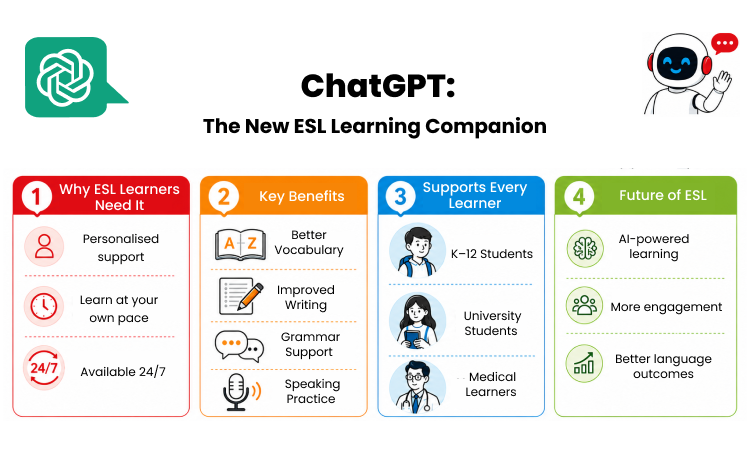
The core benefits that matter most for ESL learners:
- Instant, personalised feedback on grammar, vocabulary, and writing
- Round-the-clock access with no scheduling required
- A low-pressure environment that reduces the fear of making mistakes
- Vocabulary taught in context, not isolated word lists
More Reads: When the Algorithm Takes Over: Who’s Really Teaching Your Child, and What’s Left of the Teacher?
How Is ChatGPT in the Classroom Transforming ESL Teaching?
Ask any ESL teacher what they need more of, and the answer is almost always the same: time. Time to differentiate instruction. Time to find the right materials. Time to give every student meaningful feedback.
ChatGPT in the classroom addresses all of that. It generates CEFR-aligned lesson plans, custom worksheets, reading passages, and dialogue scripts in minutes. Koraishi demonstrated how teachers used it to produce level-appropriate reading texts with comprehension questions instantly, solving one of the most persistent challenges in mixed-ability classrooms.
Knowing how to use ChatGPT in the classroom effectively usually starts with three simple habits: giving the model clear context about the class’s level and topic, reviewing everything it generates before sharing it with students, and using it for prep and practice rather than for grading or final decisions.
Good transformational leadership in schools has always meant equipping teachers to innovate. Responsible AI integration is one of the most practical expressions of that today.
And to answer the question many educators are asking: how can ChatGPT be used in the classroom without replacing teachers? Simple. It handles the repetitive, time-consuming tasks so teachers can focus on what only humans can do: build confidence, navigate cultural nuance, and make students feel seen.
How Do Students Use ChatGPT for ESL Learning?
Students have found their own creative ways to bring ChatGPT into their language learning, often beyond what teachers officially assign. Research found that ESL learners who used ChatGPT regularly reported expanded vocabulary, improved grammar, and stronger written and conversational skills.
- Grammar correction with explanations, not just red marks
- Writing support for essays, emails, and academic assignments
- Speaking practice through simulated conversations
- Confidence-building for shy or anxious learners before speaking in class
That last point deserves attention. Language anxiety is one of the biggest barriers to ESL progress. When students can practise with an AI first, they arrive at class far more willing to try.
What Does ChatGPT in Higher Education Look Like for ESL Students?
For international students at university, academic writing in English can feel like climbing a mountain in the dark. ChatGPT in higher education provides a genuine scaffold. Students use it to structure arguments, improve their academic register, and understand citation conventions.
A study at a Hong Kong university found that students felt ChatGPT helped them summarise complex reading passages and develop more persuasive written arguments. Meanwhile, leadership in educational management at institutions that have embraced AI responsibly reports improved outcomes for their international student cohorts.
One important caveat: ChatGPT in higher education still needs human oversight. Another research found that even ChatGPT-4, despite outperforming earlier models in writing assessment, still requires teacher supervision for academic integrity and reliability.
ChatGPT in ESL Education: Benefits at a Glance
| Benefit: | What It Delivers: |
| Personalised Learning | Adapts to each student’s level and pace |
| Instant Feedback | Real-time correction without waiting for the next lesson |
| Confidence Building | Low-pressure practice reduces speaking anxiety |
| 24/7 Availability | Practice at any hour, on any device |
How Is ChatGPT in K–12 Education Being Used?
Young learners have a low tolerance for boredom. If something feels like a chore, they switch off. The best uses of ChatGPT in K12 education are the ones that feel less like studying and more like play.
- Co-writing stories with ChatGPT to practise descriptive vocabulary and narrative structure
- Vocabulary games and word challenges that make language feel interactive
- Fresh, level-appropriate reading passages generated on demand by teachers
Yuan (2023) found that chatbot integration in Chinese primary schools significantly improved English proficiency and students’ willingness to engage in English conversation. Fluency can begin far earlier than we once thought.
The importance of transformational leadership in school settings is especially clear in K–12. Leaders who build clear policies, apply content filters, and supervise AI use create environments where younger students can explore these tools safely and purposefully.
Safety and age-appropriate moderation are non-negotiable for ChatGPT in K12 education. Every school using it with younger learners should have a clear, written usage policy in place.
More Reads: The Rise of Personalised Learning in Modern Education Systems
How Is ChatGPT in Medical Education Supporting ESL Learners?
Medical students studying in English face a uniquely demanding challenge: mastering clinical knowledge while simultaneously navigating a highly specialised language. One wrong word in a patient interaction can have real consequences.
ChatGPT in medical education is emerging as a practical support for international students in this space. Leadership strategies in education that take this seriously are already building AI-supported frameworks into clinical training programmes.
- Simplifying complex medical terminology before tackling formal clinical usage
- Simulating patient interactions to build bedside manner in English
- Drafting clinical case reports with proper English structure and academic tone
What Challenges Should Educators Keep in Mind?
Let’s be honest. ChatGPT is powerful, but it is not without real problems. The concept of leadership in education includes being clear-eyed about risk, not just opportunity.
- Over-reliance: Students who use it as a shortcut miss the productive struggle that builds genuine language competence.
- Reduced critical thinking: Instant answers can discourage independent problem-solving.
- Accuracy concerns: ChatGPT can produce confident-sounding but incorrect content. Human review is always necessary.
- Digital divide: AI benefits will not reach all learners unless access barriers are addressed at an institutional level
The key is balance. ChatGPT in the classroom works best when it sits alongside strong teacher guidance, not instead of it.
What Does the Future of ESL Learning with ChatGPT Look Like?
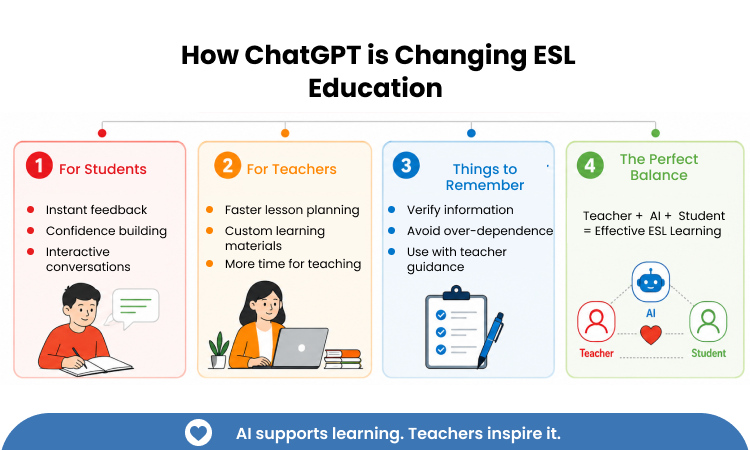
The trajectory is clear. AI-powered adaptive systems will track individual progress over time, adjusting tasks dynamically. Voice-enabled ESL tools are already emerging, enabling more natural speaking practice. Hybrid classrooms, where teachers and AI work together rather than compete, will become standard.
A 2024 systematic review found that 64% of studies on AI in language learning reported enhanced learner motivation, and 50% reported measurable improvements in language proficiency. The evidence is building. The direction is set.
The schools investing now in ethical AI frameworks and genuine personalisation, driven by the kind of impact of school leadership on student achievement that research consistently validates, will be the ones producing truly global-ready students.
Where Does This Leave ESL Education?
ChatGPT has arrived at exactly the right moment for ESL learners. More access, more practice, more personalisation than traditional methods alone can deliver.
From K–12 storytelling to university academic writing to medical communication training, ChatGPT in education is proving its value in real classrooms, with real students, backed by growing research evidence.
But the most important word in this entire guide is ‘alongside’. AI is a tool. Great teaching is the foundation. At Global Schools Group, we are committed to equipping students with English fluency, critical thinking, and digital literacy. ChatGPT in education is part of how we deliver on that promise, thoughtfully, responsibly, and always with the learner at the centre.