Table of Contents
Key Takeaways
- AI and educational technology are reshaping the teacher's role toward mentorship and personalisation, not replacing it entirely.
- GJET research confirms technology integration has genuinely increased teacher workload, making support and training essential.
- Algorithms should inform decisions (pace, data, flags); only teachers should make the pedagogical calls that follow.
- The teacher-student relationship remains something no algorithm currently replicates, and protecting it must stay central to EdTech adoption.
- GSG's SmartLearn platform is built to free up teacher time for genuine mentorship, reflecting the "technology informs, teachers decide" principle throughout.
Introduction
Somewhere between the adaptive quiz that grades itself and the app that flags which student is falling behind, a quieter question has crept into classrooms everywhere: who's actually doing the teaching anymore? Teaching with technology has become the default, not the exception, and that shift is genuinely reshaping the role of teachers in education system structures worldwide.
It's not a hypothetical worry either, walk into almost any modern classroom and you'll find dashboards, adaptive platforms, and AI-generated feedback doing work that, a decade ago, sat squarely on a teacher's desk. This piece digs into what a 2024 systematic review from the Global Journal of Educational Thoughts (GJET) found about that shift, and what it genuinely means for the humans still standing at the front of the room, not as an afterthought, but as the whole point.
What Happens When Algorithms Start Running the Classroom?
Not chaos, at least not at first. According to GJET's review of technology integration in education, well-implemented educational technology for teachers genuinely improves engagement, access to resources, and personalised pacing, real, measurable gains, not marketing promises.
Interactive simulations, gamified platforms, and adaptive software all show up in the research as genuine drivers of student motivation and comprehension. The risk isn't the technology itself, it's what happens when schools adopt it faster than they can support the humans using it, rolling out tools without the training, time, or structural backup that makes them actually work.
What Happens When the Algorithm Starts Making the Decisions?
Imagine two classrooms. In one, a teacher reads the room and she notices which student is quietly struggling, adjusts her explanation mid-sentence, and decides to revisit yesterday's concept before pressing forward. In the other, an adaptive learning platform has assessed every student's skill level and generated a personalised pathway. The algorithm decides what each child learns next, when they're ready to progress, and how their performance is measured.
Both approaches have genuine merit. But they are not the same thing and the difference matters enormously.
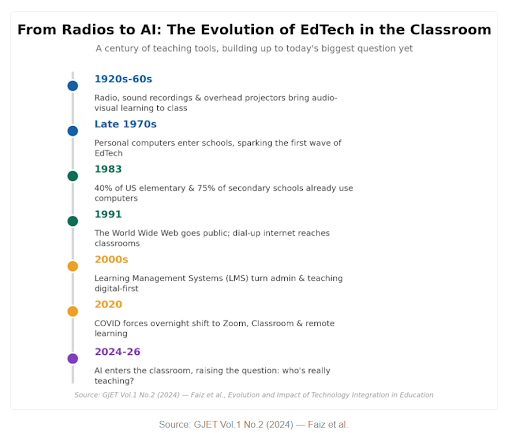
According to the GJET paper, technology integration in education has transformed teaching since its earliest manifestations: from the overhead projector of the 1960s and Computer Assisted Instruction (CAI) of the 1980s, through to learning management systems, adaptive software, and AI-driven analytics today. Each wave promised to improve educational outcomes. Most have, in measurable ways. But each has also introduced new tensions and the most profound one sits at the centre of this question: as algorithms do more of the teaching, what is left of the teacher?
As Can Schools Keep Up With the Speed of Technology? explores, the challenge for schools is not whether to adopt technology but it is how to do so without losing what makes education human.
What Did Technology Integration Actually Change And What Did It Cost?
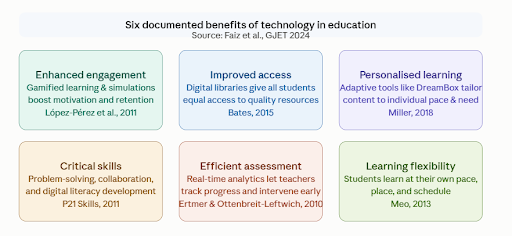
The benefits documented in the GJET paper are substantial and well-evidenced.
How Is AI Redefining the Role of Teachers in Modern Classrooms?
The GJET research traces just how fast this shift has actually moved, and the picture is genuinely striking once you see it laid out.
Today, role of teachers is shifting from sole content-deliverer toward something closer to a guide, curator, and mentor, freeing time for one-on-one attention while AI handles resource curation and routine feedback (Faiz et al., 2024). This isn't a small, gradual drift either. GSG's own research on this exact shift found that AI adoption in K-12 education reached near-universal levels during the 2024-25 school year, with teachers and students using AI in their work, a scale of adoption that makes this conversation genuinely urgent rather than theoretical. When adoption moves that fast, the question stops being "should schools use AI?" and becomes "how do we make sure teachers stay firmly in charge of it?" You can read more in our piece on how AI is empowering students and teachers to shape the future of education
Why Did Schools Rush Into Technology Faster Than They Could Manage It?
This isn't a new pattern. GJET's history section traces it back decades, and the pace has only accelerated.
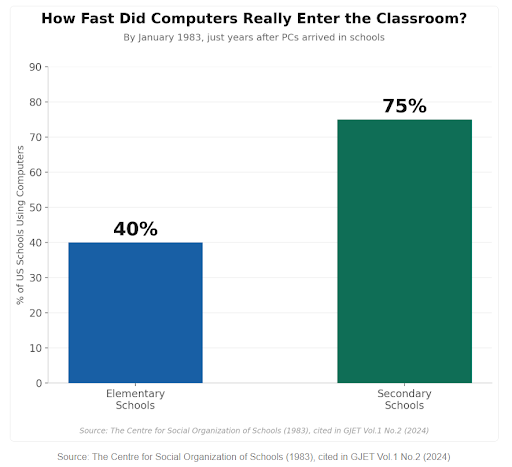
Even in 1983, adoption had outpaced training and support structures, a pattern GJET flags as recurring right through to today's AI rollout. Overhead projectors, computer labs, dial-up internet, learning management systems, each wave arrived in classrooms faster than the professional development needed to use it well. The pandemic accelerated this further still, forcing teaching with technology into every classroom almost overnight, whether staff were genuinely ready or not, compressing what might have been a decade of gradual adoption into a matter of weeks. Our blog on 10 current trends shaping the future of learning explores where this trajectory is heading next, and why the pace shows no sign of slowing.
Can AI Actually Replace a Classroom Teacher?
Short answer: no, and the GJET research is fairly direct about why not. Technology excels at scale, speed, and consistency, marking sets of quizzes in seconds, surfacing patterns across hundreds of data points, delivering the same explanation patiently a hundred times over. Teachers excel at judgment, trust, and reading a room, things no algorithm currently replicates, and arguably things no algorithm should be trusted with unsupervised.
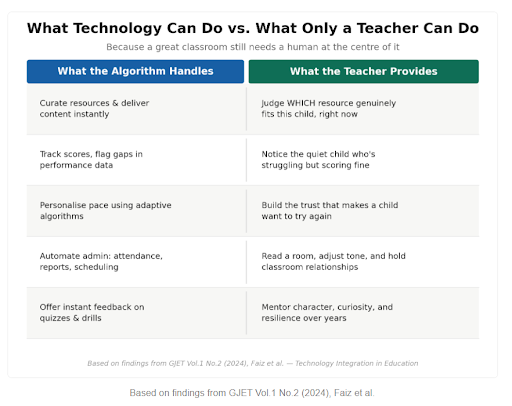
This is precisely the distinction our guide on inclusive education draws out too, AI can adapt content, but only a teacher can adapt to a child.
What Do Teachers Lose When Algorithms Run the Classroom?
Here's where GJET research gets refreshingly honest, rather than simply cheerleading for EdTech adoption. The paper found that technology integration has inadvertently led to a significant increase in teachers' workload, as educators are constantly required to manage and implement new tools on top of their existing responsibilities, lesson planning, marking, pastoral care, and now, platform troubleshooting too.
It further adds that teacher confidence and motivation directly shape how well technology gets used at all, meaning under-supported staff don't just struggle, they risk genuine burnout, and burnt-out teachers are, unsurprisingly, worse positioned to give students the attention only a human can offer. Left unmanaged, this is exactly what teachers stand to lose: time, headspace, and the bandwidth for the parts of teaching only they can do.
Is AI Eroding the Human Connection in Teaching?
Not inevitably, but the risk is real if schools lean too heavily on automation without checking in on what's actually being lost along the way. Cited in the GJET paper, warn that technology-based assessment "often neglect[s] the nuances of individualised teacher support," precisely the kind of subtle, human read that catches a struggling student before their grades ever show it. The fix isn't rejecting technology for teachers in the classroom, that ship has sailed, and rightly so, it's making sure automation handles the repetitive work so teachers have more time for connection, not less.
How Much Control Should Algorithms Have Over What a Child Learns?
GJET's answer is measured: algorithms should personalise pace and surface data, not make pedagogical decisions unsupervised. Predictive analytics can flag a struggling student; only a teacher should decide how to respond to that flag, whether that means a quiet word after class, a call home, or simply more patience over the coming weeks. This boundary, technology informs, teachers decide, is the throughline across the entire paper's findings on student achievement, teacher quality, and school management alike, and it's arguably the single clearest principle any school adopting AI should hold onto.
How Is GSG Using Technology to Empower, Not Replace, Teachers?
At Global Schools Group, this exact philosophy shapes our SmartLearn platform. As our Approach page explains, SmartLearn accounts for each student's unique strengths, weaknesses, and pace, giving teachers actionable insight for genuine one-on-one mentorship rather than replacing their judgment. The platform's purpose is explicit: better communication, better collaboration, and increased teacher productivity, not teacher redundancy. Our guide on the advantages of technology in education and our piece on the rise of personalised learning both reflect this same balance, technology doing the heavy lifting, teachers doing the teaching, exactly the principle GJET's research points toward.
Conclusion
The algorithm hasn't taken over, not really, but it has changed what "teaching" looks like day to day, and schools that ignore that shift risk losing exactly what makes teaching work: judgment, trust, and genuine human attention. At GSG, teaching with technology means using tools like SmartLearn to strengthen that human core, not sideline it, giving teachers real data and real time back, so they can do what algorithms simply cannot.
Ready to see technology and teaching done right? Enquire now!
FAQs
What does the GJET research say about Teaching with technology?
The GJET research highlights both the opportunities and challenges of teaching with technology, including personalised learning, improved access to information, and greater collaboration. It also stresses that successful technology integration requires careful planning, teacher support, and meaningful implementation rather than simply adding more digital tools to the classroom.
Is AI actually replacing teachers in GSG schools?
No. Across GSG schools, technology and GSG’s SmartLearn platform are designed to support teachers with data, personalisation, and digital learning tools. AI cannot replace the judgment, mentorship, creativity, and human relationships that teachers bring to the classroom.
Which GSG global campuses offer advanced technology and future-ready learning spaces?
Several GSG global campuses provide technology-rich learning environments. For example, GIIS Whitefield, Bangalore, features advanced digital classrooms and innovation labs, while GIIS Bannerghatta, Bangalore, offers smart classrooms alongside science and computer labs. OWIS Whitefield, Bangalore, includes design labs and ICT spaces, and OWIS Sarjapur, Bangalore, combines digital classrooms with advanced science labs. These environments give students opportunities to learn through technology, experimentation, and practical exploration.
How does educational technology for teachers address the workload challenges identified in GJET research?
The GJET research recognises that technology can increase teacher workload when implementation lacks sufficient planning and support. Well-designed educational technology for teachers, combined with professional development and clear processes, can help educators use digital tools more effectively while avoiding unnecessary complexity in their daily work.
How is technology for teachers in the classroom used without reducing human interaction?
Effective technology for teachers in the classroom should make teaching more responsive, not more distant. Digital and personalised learning tools can help educators understand student progress and identify areas requiring additional support, potentially creating more opportunities for meaningful one-to-one guidance and classroom interaction. By using personalised learning tools to free up teacher time for one-on-one mentorship, rather than to reduce human contact.
Where can I learn more about AI and technology across GSG schools?
Explore our guide on how AI is empowering students and teachers for a deeper look at how AI can support learning, strengthen the work of educators, and shape more purposeful technology integration in modern classrooms.
Author Bio:
Harizah Faiz leads this study from the GCEE Research Centre at Global Schools Group, joined by Shakilah Chandrasegaran of Taylor's International School and four co-authors from Malaysia's Ministry of Education: Natasha Nuralanis Zulkipli, Aziah Abdol Aziz, Azman Hariffin, and Macliffton Tembak Sinau. Together, the team traces how classroom technology has evolved from early audio-visual tools to today's AI-driven platforms, and examines what that shift has actually meant for student achievement, teacher quality, and school management. Their research weighs genuine gains in engagement and personalised learning against real costs like rising teacher workload, the digital divide, and data privacy concerns.