Our schools are fully dedicated to the principles of water conservation, efficient utilization, and recycling within their premises. Monthly monitoring and measurement of our water consumption guide our ongoing efforts to use water judiciously. Furthermore, we have implemented a range of initiatives across our various campuses to minimize water wastage significantly.
As we follow a whole school approach to sustainability involves integrating sustainable practices into every aspect of a school’s operations, curriculum, and culture. This way emphasizes the importance of sustainability in education and encourages students, teachers, and staff to develop an understanding of sustainability issues and to take action to reduce their environmental impact.
Some of the key highlights of our water conservation efforts include:
Rainwater Reuse in Singapore: We have implemented an extensive rainwater harvesting system on a large scale. Massive water retention tanks, positioned five meters below the parking areas, capture and store a substantial portion of the rainwater that falls on our campuses. This stored rainwater is subsequently reused to supply water for maintaining our lush green landscapes, as well as powering our decorative water fountains and other related purposes.
NEWater Integration & Green fittings in Singapore Campus: In selected areas of our campuses, we utilize Singapore’s unique processed water, NEWater, for specific utility needs like cleaning. To further enhance water efficiency, our washrooms are equipped with green labelled fittings as per PUB (Public Utilities Board) requirements. This helps us in reducing our water consumption.
Rainwater Harvesting in Indian campuses: Many of our campuses employ rainwater harvesting systems. These systems collect rainwater from rooftops through a network of pipes, channelling it to underground recharge pits. Any excess rainwater is directed to the harvesting tank. The stored rainwater is then repurposed for landscaping and other non-potable uses.
We currently have rainwater harvesting system in GIIS Nagpur, Whitefield, Bannerghatta, Ahmedabad and Vikaasa world, Madurai ; the capacity ranges for 66000 litres to 200000 litres.
Sewage Treatment Plant (STP) in Indian campuses : Sewage Treatment Plants (STPs) are designed to treat and purify wastewater generated on campus, ensuring that water discharged into the environment meets established standards for cleanliness. Sewage treatment plants treat sewage in the most effective and efficient way possible, in order to remove all impurities, pathogens, and pollutants and prevent the water from being wasted. We have a Sewage treatment facility in GIIS Nagpur, Hadapsar, Noida, Ahmedabad, Whitefield, Bannerghatta, Glendale Academy, Hyderabad and Vikaasa World, Madurai ranging from 26 Kilolitres per Day to 66 Kilolitres per Day.
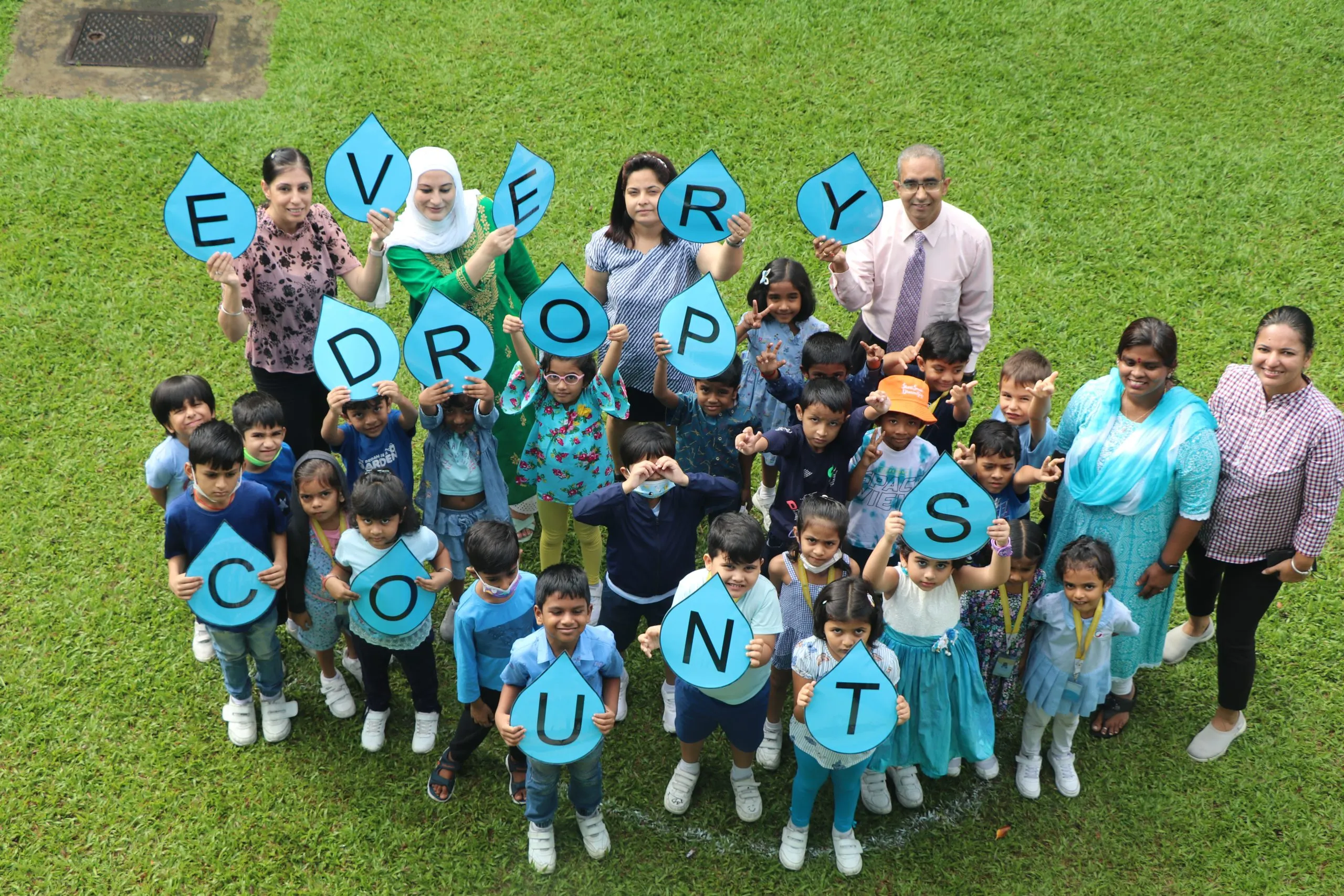
Student Involvement and Impact: Beyond our institutional initiatives, our students are the driving force behind water conservation, actively promoting it not only within our school but also in their own homes. They are the face of our commitment to sustainability.
These water initiatives are also a practical example of how eco-friendly school projects create environmental change and how schools can become more environmentally sustainable, as explained below.
Here are some practical ways in which our students contribute for water conservation initiatives :
- Raise Awareness: Our students and staff have done numerous educational campaigns to inform fellow students and teachers about the critical importance of water conservation.
- Smart Actions to conserve water: Some actions our schools promote for our students to Save Water, Smartly and Sustainably. Some of those are
- Turn off Taps: There are reminders and posters in schools to promote the responsible use of water by ensuring that taps are fully turned off after use.
- Use of Reusable water bottles: We encourage the adoption of reusable water bottles as a sustainable alternative to disposable plastic bottles, thereby reducing plastic waste and conserving water resources. Shorter Showers: Advocate for shorter shower durations among family members to reduce water consumption.
- Fix Leaks: There have been kaizen and QC projects related to promptly report and address any leaks in faucets, toilets, or pipes at schools and at home. We have achieved remarkable results with these projects
- Student projects: Our students have undertaken captivating projects centred on water conservation and purification. One particularly intriguing endeavour involved the use of durian husks, a fruit by-product, for water purification, yielding impressive results.

Pic 1 : Student colouring awareness poster

Pic 2: Project using Durian husk for water purification
By actively participating in these water conservation initiatives both at school and at home, students make a significant contribution to safeguarding our precious water resources for future generations. These initiatives provide practical experiences and valuable lessons that go beyond textbooks, fostering a sense of responsibility and environmental consciousness
How Do Eco-Friendly School Projects Contribute to Environmental Change?
Eco-friendly school projects contribute to environmental change by reducing resource use on campus, giving students practical experience of environmental solutions, and carrying sustainable habits into homes and communities. Water conservation is a clear example.
The water initiatives in GSG schools show four ways this happens:
- They save resources. Rainwater harvesting reduces the demand for fresh water. In Singapore, stored rainwater is reused for landscaping and fountains, and NEWater is used for cleaning. In India, harvested rainwater is used for landscaping and other non-potable purposes.
- They protect the environment. Sewage treatment plants at several Indian campuses treat wastewater so that what is discharged meets established standards for cleanliness.
- They make progress measurable. Monthly monitoring of water consumption helps schools see where water is being used and where it can be saved.
- They change behaviour. Awareness campaigns, tap reminders, reusable water bottles and leak-reporting projects carry water-saving habits from school into students’ homes. Student projects, such as using durian husks for water purification, show students applying science to a real environmental problem.
Because students take part in these projects, they learn why the actions matter, which is what makes the change last.
More Reads: Building a Greener Tomorrow: The GSG Green School Certification Story
How Can Schools Become Environmentally Sustainable?
Schools become environmentally sustainable by taking a whole-school approach: building sustainability into operations, the curriculum and school culture, rather than relying on isolated activities. This means measuring resource use, investing in efficient systems, and involving students and staff in everyday action.
Six steps help schools get started:
- Measure resource use. Track water, energy and waste regularly, as GSG schools do with monthly water monitoring, so efforts target real waste.
- Invest in efficient systems. Rainwater harvesting, water-efficient fittings (such as the PUB-labelled fittings in Singapore campus washrooms) and sewage treatment plants cut waste and protect water quality.
- Reuse where possible. Use harvested rainwater and treated water for landscaping, cleaning and other non-drinking purposes.
- Involve students. Awareness campaigns, improvement projects and student research give learners real ownership.
- Build everyday habits. Simple actions such as turning off taps, using reusable bottles and reporting leaks work at school and at home.
- Connect it to learning. Link sustainability projects to lessons so students understand the reasons behind the actions.
Sustainability lasts when it is part of how a school runs and teaches, not a single campaign.
More Reads: The Certification Trap: How Global Schools Group Rewired What “Sustainable School” Really Means