Table of Contents
Key Takeaways
- AI does not replace teachers. Research from Global Indian International School, Ahmedabad, published in the GJET (2026), confirms that AI is a pedagogical resource that amplifies what educators do, supporting reflective, ethical, and experiential learning rather than replacing the human connections that define great teaching.
- AI personalises learning at scale. Through systems thinking simulations, adaptive inquiry tools, and generative AI that sustains classroom discourse, every student can engage at their own pace and depth without a single student being left behind or unchallenged.
- Real examples prove it works. In one GSG school, students examined their own school’s energy, water, and waste data through an AI visualisation tool and asked questions that no textbook could have prompted. In another, students designed smart irrigation systems and carbon usage models, practising the kind of thinking the world urgently needs.
- Students and teachers must both evolve. Students shift from passive receivers to active designers and ethical thinkers. Teachers shift from knowledge providers to facilitators of deeper inquiry. Both roles become more powerful, not less, when AI is present and purposefully used.
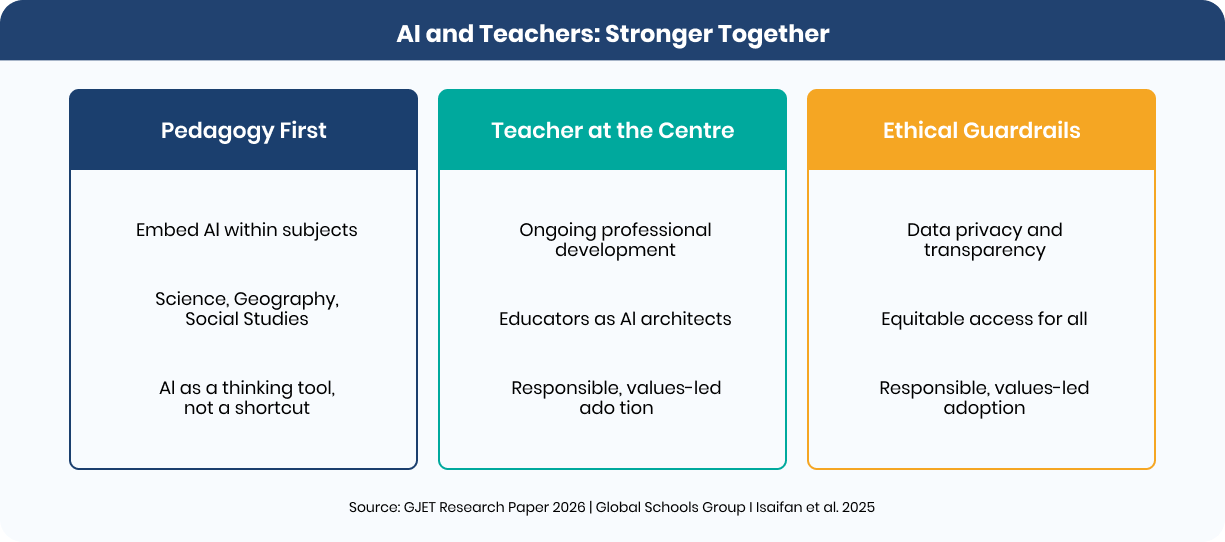
- Ethical and purposeful integration is what makes the difference. AI must be embedded within subjects, not treated as a standalone class. Teachers need structured professional development. Leadership must ensure data privacy and equitable access. And ethics must be part of learning itself, not just school policy.
At GSG, we have always believed that education is one of the most profoundly human things we do. It is where values are formed, where curiosity finds its wings, and where young people begin to understand their place in the world.
So when artificial intelligence began reshaping classrooms around the world, we did not ask whether it would replace teachers. We asked something far more interesting: how can students and teachers embrace AI to learn, grow, and lead in ways that were never possible before?
That question now has a research-backed answer, developed by our own educators at Global Indian International School, Ahmedabad, and published in the Global Journal of Educational Thoughts. It builds on our ongoing commitment to striking the right balance between technology and tradition This blog brings those findings into the conversation; alongside the concrete school-based examples the research presents.
The paper, Leveraging Artificial Intelligence for Advancing Sustainable Development Practices Among Students , positions AI as a pedagogical resource for reflective, ethical, and experiential learning. It does not position AI as a replacement for teachers. It positions AI as a tool that makes great teachers even more powerful and every student more capable.
The Importance of AI in Education: What Every Parent and Educator Needs to Know
How is AI changing education for students and teachers today?
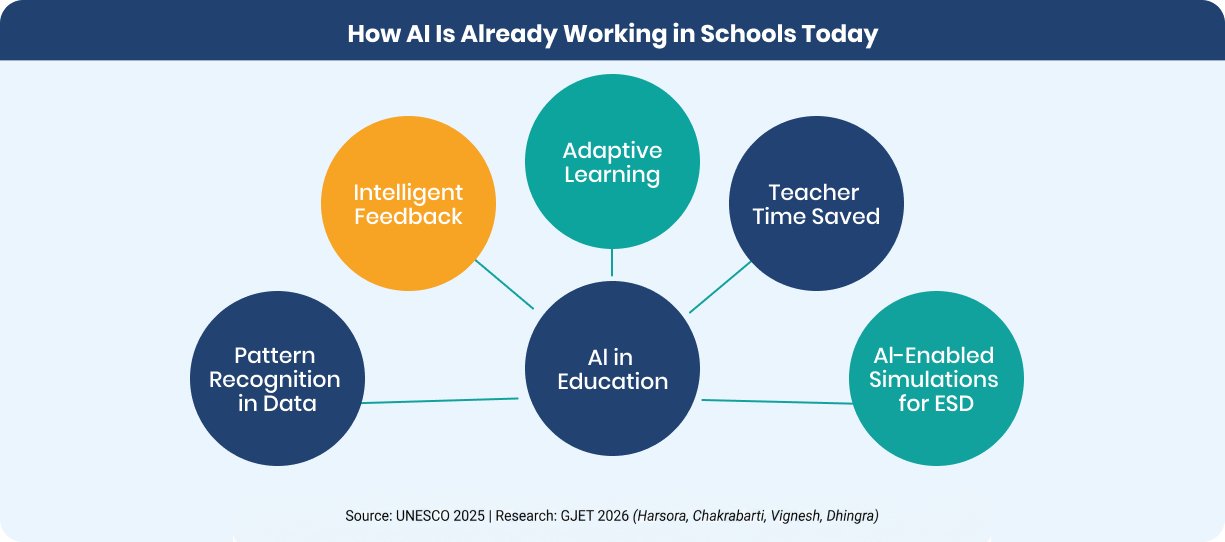
According to the GJET research paper (2026), AI in education encompasses adaptive feedback, pattern recognition, and personalised learning pathways. It strengthens three specific areas of learning: systems thinking, personalised inquiry, and collaborative knowledge building.
Artificial intelligence is no longer a distant possibility for schools. It is already embedded in the tools students and teachers use daily, from adaptive learning platforms that respond to a student's pace, to analytics systems that help teachers understand where a class is struggling before the test arrives. UNESCO links AI directly to Sustainable Development Goal 4: Quality Education for All, positioning it as a driver of educational equity and excellence.
We have identified 3 specific ways AI strengthens teaching and learning.:
- AI-driven simulations and analytics help students explore complex environmental and social systems.
- Adaptive tools tailor learning pathways to individual interests.
- And generative AI supports sustained classroom discourse, encouraging students to articulate, critique, and refine ideas together. Each of these works because a teacher is present to give it purpose and direction.
The Real Impact of AI in Education: What GSG Researchers Found in Real Classrooms
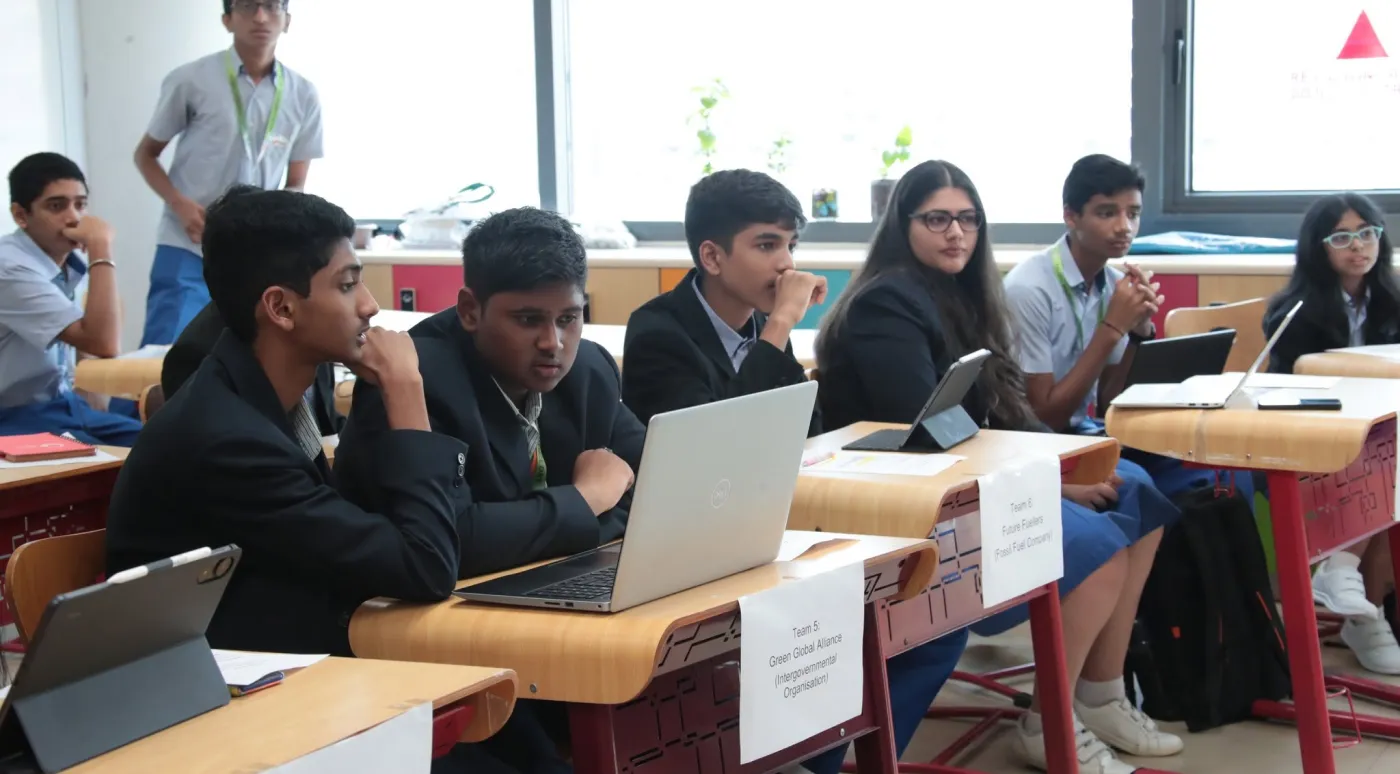
Our research presents 2 school-based examples from Cambridge and CBSE-aligned settings. In both, AI functioned as a thinking tool rather than a technology subject. Students used AI to examine real sustainability challenges in their own schools and communities, producing deeper inquiry, stronger ethical reasoning, and more meaningful engagement than traditional methods alone.
The research paper documents both examples in detail. Here is what learning looked like in each school:
AI for Resource Awareness in the School Environment | Student-Led AI Design within Sustainability Projects |
Setting A school where sustainability is a cross-curricular priority embedded across science, geography, and social studies, aligned with Cambridge and CBSE frameworks. | Setting Upper primary or secondary school using project-based learning. Students take an active role in identifying real environmental issues in their school or community. |
What Students Did Accessed their school’s own data on energy consumption, water usage, and waste generation. Used an AI visualisation tool to surface patterns over time. Interpreted the data, debated its causes, and discussed who was responsible for change. | What Students Did Used AI design platforms to conceptualise responses to community environmental challenges. Some designed smart irrigation models for water-scarce areas. Others created carbon usage visualisations to understand the footprint of everyday decisions. |
Role of AI Non-prescriptive. Applied pattern recognition to surface trends. Made the invisible visible. Did not provide answers. Functioned as a cognitive scaffold for student-led inquiry. | Role of AI Handled technical complexity through simplified interfaces and pre-trained algorithms. Freed students to focus entirely on design thinking, ethical reflection, and contextual relevance rather than coding. |
Role of Teacher Made the conversation meaningful. Facilitated guided inquiry into data representations, questioning assumptions, and discussing ethical considerations of environmental stewardship. | Role of Teacher Guided students in examining sustainability challenges through scientific, social, and ethical lenses simultaneously. Framed sustainability as complex and evolving, not a problem with one right answer. |
The Lasting Lesson The AI made the invisible visible. The teacher made the conversation meaningful. Together, they turned routine school data into genuine environmental inquiry, the kind that stays with a student long after the lesson ends. | The Lasting Lesson A student designing an irrigation system for a farmer she will never meet is not doing a school project. She is practising the kind of thinking the world urgently needs. |
How AI Will Personalise Education at Scale: Two Real Examples from GSG Schools
The GJET research paper (2026) shows that AI personalises learning through three pathways: systems thinking simulations that adapt to the complexity a student can handle, personalised inquiry tools that adjust to individual pace and interest, and generative AI that sustains collaborative discourse at the class's own level. No two students experience the lesson in exactly the same way.
For decades, classrooms have been designed for the average student. A single lesson pace, a single explanation, a single assessment for thirty different minds. AI changes that equation entirely. The most powerful promise of AI in education is not efficiency. It is personalisation at scale: every child learning at their own pace, supported by tools that adapt in real time, without replacing the teacher who sees the whole child.
How AI personalises learning for every student, from the GJET research paper (2026):
- Systems Thinking: AI-driven simulations allow students to observe how climate systems, resource flows, and environmental consequences interact, making invisible processes visible. A student who struggles with abstract causation can interact with the system directly, adjusting variables and watching outcomes change in real time.
- Personalised Inquiry: Adaptive AI tools tailor learning pathways to each student's pace and interests. In the GSG school example documented in the research paper, students at different levels of environmental understanding all engaged with the same school energy data, but each asked different questions and reached different depths of analysis.
- Collaborative Knowledge Building: Generative AI sustains richer classroom conversations, encouraging students to articulate, critique, and refine ideas together. The research paper cites Lee, Tan, and Teo (2023) on how generative AI fosters knowledge creation rather than passive consumption.
For more on how this connects to career preparation, see our blog on how schools must prepare children for an evolving job landscape. A further GJET paper, Teaching with AI: A Bold New Approach, explores how AI tools are already being used across GSG's school network to strengthen inquiry-based learning.
How AI-supported learning compares with traditional classroom-only approaches
Skill Area | AI-Supported Learning | Traditional Classroom Only |
Learning approach | Inquiry-based, experiential, sustainability-focused | Content-heavy and exam-focused |
Student role | Active designer and ethical thinker | Passive receiver of content |
Teacher role | Facilitator of inquiry and ethical guide | Primary knowledge deliverer |
Problem-solving | Real-world, open-ended sustainability scenarios | Fixed-answer problem sets |
Readiness for change | Adaptability and systems thinking | Primarily syllabus-driven |
Beyond Replacement: How Students and Teachers Are Embracing AI Together
AI must amplify human pedagogical agency, not replace it. For students, the shift is from passive recipient to active designer and ethical thinker. For teachers, the shift is from knowledge provider to facilitator of inquiry. Both shifts require intentional design, professional development, and a school culture that values reflection over performance.
The question of whether AI will replace teachers fundamentally misunderstands what teaching is.
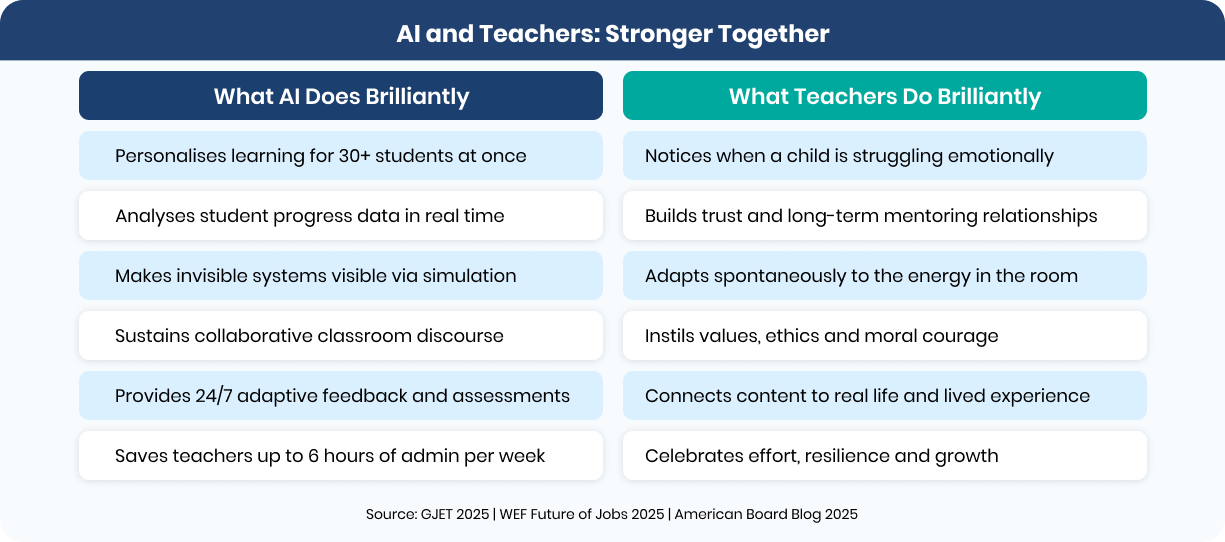
- A teacher notices when a child goes quiet on a Monday morning because something is wrong at home.
- A teacher connects a lesson on climate change to a student's genuine fear for their future.
- A teacher celebrates effort, resilience, and the courage to try again. No algorithm has been built to do any of that.
What the research paper makes clear is that the real transformation is not replacement. It is role evolution. Students move from passively receiving knowledge to actively constructing it, using AI as a tool to investigate, design, and reflect. Teachers move from delivering information to facilitating the inquiry that helps students make meaning from it. Both roles become more powerful, not less, when AI is present.
What the Research Paper Says Schools Must Do |
Curriculum: AI should be embedded within existing subjects such as science, geography, and social studies, not taught as a standalone technology class. This ensures sustainability remains a cross-cutting educational priority. Teachers: Educators need structured opportunities to develop confidence in facilitating AI-supported, inquiry-based learning. Professional development must focus on pedagogical intent, not just tool familiarity. Leadership: School governance frameworks must shape responsible AI adoption. Both Cambridge and CBSE emphasise values-based education and responsible global citizenship. Ethics: Data privacy, transparency, and algorithmic bias should be incorporated into learning itself, enabling students to critically reflect on the social and environmental implications of digital technologies. |
From the Classroom to the Community: How GSG Students Are Tackling Real Sustainability Challenges
There is one area where AI and education become truly extraordinary together, and it is the area closest to our hearts at GSG: sustainability.
Education for Sustainable Development (ESD), as the research paper frames it, aims to meet present needs without compromising the future. It emphasises learning that is participatory, interdisciplinary, and action-oriented, encouraging students to engage with real-world challenges and adopt responsible behaviours.
AI's potential to model complex systems, personalise engagement with sustainability concepts, and support data-driven inquiry uniquely aligns with these goals. The research paper puts it directly: AI-powered simulations can make invisible environmental processes visible, supporting higher-order thinking about climate systems, resource flows, and societal impacts.
Skills students develop when AI meets sustainability education, from the GJET research paper (2026):
- Critical and systems thinking, developed by exploring real environmental challenges through AI-powered simulation and data analysis
- Research and communication skills, built through structured AI-supported inquiry projects, presentations, and peer debate
- Ethical reasoning, cultivated by reflecting on the social and environmental implications of the technology students are using to learn
- Adaptability and global awareness, connecting local school-level action to global sustainability impact across disciplines
At GSG, this is already alive in our schools. Our Green School Certification, now active across more than 20 campuses, embeds sustainability across all five dimensions of school life. Our student-led Mock COP programme saw over 100 students implement their own climate action plans in 2024, reaching more than 30,000 peers. AI is becoming the thinking tool that powers this work deeper.
The Future of Education: Why Schools That Choose AI and Teachers Together Will Lead
AI has the potential to strengthen sustainability education when embedded within reflective, experiential, and competency-focused learning environments. The future of education belongs to schools that use AI purposefully, ethically, and always in service of the learner.
AI will not replace teachers. What it will do, when used as the research paper describes, is make the invisible visible, give every learner a personalised pathway, and free educators to do what only humans can: design with intent, respond with empathy, and teach with purpose. A student examining her school's energy data and asking why the numbers look the way they do. A student designing an irrigation system and asking who benefits from it and who does not. Neither of these is a technology lesson. Both are education at its best.
At GSG, we embrace artificial intelligence because it serves something timeless: every child's right to learn deeply, think freely, and grow into someone the world genuinely needs. Read the full GJET research paper (2026) and explore how GSG schools are shaping this future at globalschools.com.