Table of Contents
Why Mathematical Thinking Is a Leadership Skill, Not Just a Classroom Requirement
Mathematical thinking is a leadership competency. Research published in the Global Journal of Educational Thoughts of One World International School Riyadh confirms that the cognitive skills developed through mathematical education - logical reasoning, problem decomposition, quantitative analysis, modelling, and reflective evaluation - align directly with the five core processes of strategic decision-making used by business leaders worldwide.
Every parent wants their child to succeed in a world that is increasingly complex, data-driven, and unpredictable. Yet one of the most important questions often goes unasked: what kind of thinking is a school actually developing?
Our peer-reviewed research of 2026 published in the Global Journal of Educational Thoughts by One World International School Riyadh suggests that mathematical thinking is not just an academic skill, but a foundational leadership capability. The cognitive processes developed through mathematics — logical reasoning, problem decomposition, quantitative analysis, modelling, and reflective evaluation — align closely with the way effective leaders make strategic decisions.
5
Mathematical thinking skills proven to build strategic leadership capacity
5
Strategic decision-making stages they each directly strengthen
64
GSG campuses applying research-backed approaches across 11 countries
What Is Mathematical Thinking, and Why Is It Different from Being Good at Maths?
Mathematical thinking, as defined by Schoenfeld (2016) and cited in the our in-house research paper, is a dynamic cognitive cycle: comprehending a problem, planning a strategy, monitoring progress, and reflecting critically on conclusions. It is entirely distinct from computational accuracy. A student can be excellent at solving equations and poor at mathematical thinking - or vice versa. The cognitive outcomes are not the same, and the leadership implications are significant.
Being good at maths - in the way most schools measure it - means arriving at the correct answer using the right method. Mathematical thinking means something deeper: understanding why the method works, questioning whether the problem was framed correctly, testing assumptions before committing to an approach, and evaluating whether the answer actually solves the original challenge. This cycle of reasoning is what Schoenfeld (2016) describes as disciplined metacognition - and it is the same cognitive process a strategic leader uses when navigating a major organisational decision.
The GJET research paper makes an important distinction that most curricula have not yet caught up with: mathematical thinking is transferable across every context a student will encounter in their professional life, while computational proficiency is domain-specific. A student who has internalised mathematical thinking as a habit of mind does not just know how to solve a quadratic equation. They know how to approach an unfamiliar problem, decompose it systematically, evaluate their options with evidence, and reflect critically before committing to a conclusion. That is the skill that distinguishes strong leaders from good performers.
This understanding is at the heart of GSG's educational philosophy. Read our perspective on striking the right balance between technology and tradition to understand how we embed this kind of thinking across our Cambridge and CBSE-aligned curricula - and explore the full body of GSG research on the GJET Journal Coverage page.
Mathematical Thinking vs. Computational Proficiency: What Is Actually Being Built?
Dimension | Mathematical Thinking | Computational Proficiency |
Primary cognitive outcome | Transferable reasoning framework | Domain-specific procedural skill |
How problems are approached | Open-ended: What is really being asked? | Closed: Which formula applies here? |
Role of assumptions | Explicit: tested, varied, questioned | Implicit: given in the problem |
Response to being wrong | Information to analyse and learn from | Error to correct and move past |
Reflection | Built into the process | Optional, after-the-fact |
Applicability in leadership | Every complex decision, across industries | Finance, accounting, operations only |
Why Do Parents Underestimate Maths - Is treating maths as a subject about correct answers holding children back from leadership?
Yes. The GJET research paper (2026) identifies this as one of the most significant and often overlooked educational misunderstandings. When parents and schools frame mathematical success as reaching the correct answer, this can unintentionally deprioritise the reasoning process that actually determines long-term leadership capability. Mathematical thinking is built through how maths is taught, not through which subjects a child study most. Redirecting children toward coding, science or language while treating maths as a computation exercise misses the cognitive foundation that all those subjects ultimately depend on.
There is a pattern that shows up across cultures and school systems worldwide. Parents who are highly invested in their child's education often redirect effort away from mathematics toward subjects they perceive as more immediately useful. Maths, in their mental model, is about passing examinations. It is a hurdle, not a foundation.
So, when a child struggles with maths or finds it less engaging, the instinct is to redirect energy elsewhere.
Understanding this distinction is one of the most valuable things a parent can do when evaluating schools. The cognitive foundations built in the earliest years of learning -through open-ended exploration, pattern recognition, and guided reasoning -determine what kind of thinker a child becomes. Read our blog on early learning and the foundations GSG builds from the very start.
Mathematical thinking - the cognitive process of reasoning, assumption-testing, and reflective evaluation - is not produced by studying mathematics as a list of methods. It is produced by practising mathematics as a reasoning discipline. A child who spends five years completing maths worksheets correctly has built procedural accuracy. A child who spends five years questioning assumptions, modelling scenarios, and evaluating the quality of their conclusions has built a leadership mind. These are not the same outcome.
The Three Most Common Parental Assumptions About Maths – and What the Research Actually Shows:
Common Parental Assumption | What our Research Shows |
“Maths is about getting the right answer.” | Mathematical thinking is about reasoning quality, not answer accuracy. Schoenfeld (2016) defines it as a cycle of comprehension, strategic planning, monitoring, and reflection – the cognitive process that builds leadership capability, not examination scores. |
“Coding and science matter more for my child’s future.” | Mathematical thinking is the cognitive foundation all subjects build upon. Boaler (2022) confirms that students taught maths as a reasoning process develop stronger analytical capability across every discipline – including coding, science, and strategic leadership. |
“If my child is good at maths, they are a mathematical thinker.” | Not necessarily. A high-scoring maths student may have excellent procedural recall and poor reasoning habits. The research distinguishes clearly between computational proficiency (domain-specific) and mathematical thinking (universally transferable). The thinking determines leadership potential. |
What Happens to Students Who Are Taught Maths Without Being Taught to Think?
Students taught mathematics purely as computation develop strong procedural accuracy but limited cognitive transferability. When they encounter business challenges - which are almost always ambiguous, multi-variable, and resistant to standard formulas - they struggle to structure the problem, test assumptions, or model alternative outcomes. Research confirms that computational instruction alone does not develop the analytical adaptability, persistence under uncertainty, or reflective judgment that strategic leadership requires (Boaler, 2022; OECD, 2023
Why does computational-only maths education leave students underprepared for leadership?
Most schools measure mathematics success by examination performance. This creates a systemic bias: teachers optimise for correct answers, students optimise for familiar methods, and the cognitive habits that actually matter for leadership - questioning assumptions, decomposing complexity, and evaluating evidence - receive little or no structured development. A student can score top marks in a mathematics examination and still be a poor strategic thinker.
The GJET research paper identifies this as a significant gap in current business education specifically. MBA programmes frequently treat mathematics as a technical requirement associated with finance and accounting rather than as an integrated leadership competency. This compartmentalisation limits the contribution of mathematical education to leadership development and produces graduates who can run a financial model but struggle to interrogate its assumptions or interpret its limits.
Research Insight | Why This Gap Matters |
The research paper draws on Davenport and Bean (2023) to confirm that as of 2025, leaders must be able not only to access analytical tools but also to critically interpret and evaluate them. Computational proficiency provides the first capability. Mathematical thinking provides the second. Without the second, data-driven leadership is an illusion: leaders accept analytical outputs rather than interrogating them, reinforcing rather than reducing bias in strategic judgment. |
The implications for parents are equally direct. A school that teaches mathematical thinking produces graduates who approach every professional challenge - regardless of industry or role - with a disciplined cognitive process. A school that teaches mathematical computation produces graduates who are well-prepared for familiar problems and poorly prepared for everything else. In a world defined by rapid change, data abundance, and genuine complexity, the difference matters more than any examination ranking.
How Does Mathematical Thinking Build the Skills Every Business Leader Relies On – The 5 Cognitive skills
The GJET research paper (2026) identifies five specific cognitive skills developed through mathematical education that map directly onto five stages of strategic decision-making. These are not soft analogies - they represent a precise structural alignment between how mathematics education trains the mind and how effective leaders navigate complexity, risk, and uncertainty. As of 2025, the OECD confirms that analytical and quantitative reasoning rank among the most critical competencies for future-ready professionals globally.
Every parent wants their child to succeed in a world that is increasingly complex, data-driven, and unpredictable. Yet one of the most important questions often goes unasked: what kind of thinking is a school actually developing? Our peer-reviewed research of 2026 published in the Global Journal of Educational Thoughts by One World International School Riyadh suggests that mathematical thinking is not just an academic skill, but a foundational leadership capability. The cognitive processes developed through mathematics — logical reasoning, problem decomposition, quantitative analysis, modelling, and reflective evaluation — align closely with the way effective leaders make strategic decisions.
The Five-to-Five Framework: From Mathematical Thinking to Strategic Leadership – 2026, research paper:
Mathematical Thinking Skill | Built Through | Maps to Leadership Stage | Leadership Outcome |
Logical reasoning | Constructing and testing evidence-based arguments | Problem definition | Reduces cognitive bias; evidence-based judgment |
Problem decomposition | Breaking complex challenges into component variables | Alternatives evaluation | Clearer diagnosis; sharper strategic options |
Quantitative analysis | Interrogating data quality and model assumptions | Risk assessment | Stronger evidence evaluation; less noise in judgment |
Modelling and scenario planning | Building and stress-testing outcome maps | Scenario planning | Enhanced resilience; preparedness for volatility |
Reflective evaluation | Assessing conclusions and revising assumptions | Post-decision review | Organisational learning; adaptive leadership |
What makes this framework significant is that it is not theoretical. Each of these five skills is developed through specific, identifiable pedagogical practices in mathematics classrooms - practices that are either present or absent, depending on how a school approaches the subject. And each one corresponds to a measurable leadership capability. Leaders who have developed strong mathematical thinking through education are better equipped to frame wicked problems with clarity, evaluate data with rigour, plan under uncertainty, and adapt strategies when outcomes diverge from expectations.
This also connects directly to how GSG is preparing students for careers in an AI-driven world. Read our blog on how schools must prepare children for an evolving job landscape to understand how mathematical thinking connects to the future of work - and how GSG schools embed this across our AI and sustainability programmes.
How Can Schools and Educators Develop Mathematical Thinking Step by Step?
The following five steps are derived directly from the research paper's implications for educational practice. They represent a practical pathway for educators and school leaders seeking to embed mathematical thinking as a cognitive leadership competency within existing Cambridge and CBSE curriculum frameworks.
01. Design Problems That Reward Reasoning, Not Just Correct Answers
Reframe mathematical problems to be open-ended, with multiple valid approaches. Shift assessment criteria to reward the quality of reasoning and justification alongside correct outcomes. When students know they are evaluated on how they think, not only on what answer they reach, they begin to invest cognitively in the process. This is the foundational shift from which all other mathematical thinking development flows.
02.
Make Assumption-Testing an Explicit Part of Every Lesson
Before students begin solving any mathematical problem, require them to identify and articulate the assumptions embedded in it. After reaching a conclusion, require them to vary the key assumptions and observe how the outcome changes. This habit - asking what if this assumption is wrong? - is identical to the scenario-planning skill that Teece, Peteraf, and Leih (2016) identify as foundational for strategic resilience in business leadership.
03.
Build Structured Reflection Time into the Learning Process
Allocate deliberate time at the end of mathematical tasks for students to evaluate their approach: Did this method address the actual question? What assumptions were made? What would change under different conditions? This mirrors the post-decision reflection that the OECD (2023) identifies as critical for organisational learning. Leaders who have practised this habit through years of mathematics education do it automatically in strategic contexts.
04.
Connect Mathematical Reasoning Explicitly to Real-World Decision Contexts
Frame mathematical problems within the contexts students will encounter professionally: business decisions, resource allocation, risk assessment, data interpretation. Students who understand that the reasoning process they are practising is the same one business leaders use daily engage more deeply and retain the cognitive habits longer. This is not about making maths feel easier - it is about making its leadership value visible.
05.
Embed Mathematical Thinking Across Subjects, Not Only in Mathematics Lessons
Mathematical thinking must be practised cross-curricularly to become a durable cognitive habit. Science lessons that require evidence evaluation, social studies projects that involve data interpretation, and leadership programmes that use scenario modelling all build the same cognitive pathways. This cross-disciplinary integration is exactly how GSG embeds analytical reasoning - from our student-led
At GSG, students apply mathematical thinking to real-world sustainability challenges through our Voices for the Future Mock COP programme and our Green School Certification framework - where data reasoning, systems thinking, and evidence-based action are built into how students engage with the world around them.
Why does mathematical thinking remain irreplaceable in an AI-driven world, and what does this mean for how we educate children today?
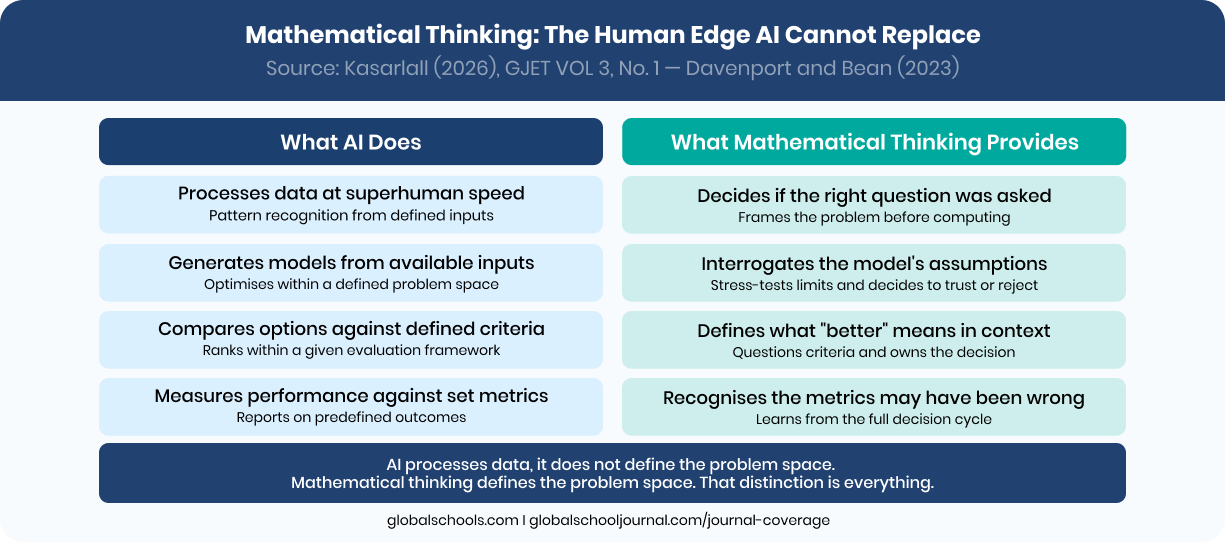
Yes. AI can compute with speed and scale no human can match. What AI cannot do is determine whether the computation was the right one to run - whether the problem was framed correctly, whether the model's assumptions are valid, and whether the output should be trusted, revised, or rejected. These are acts of mathematical thinking. The GJET research paper (2026) positions mathematical thinking as the cognitive framework that enables leaders to interrogate analytical tools rather than merely use them - precisely the human capability that AI amplifies but cannot replace.
As of 2026, AI can write code, generate financial models, synthesise research, and produce strategic presentations at a level that exceeds most junior professionals. What it cannot do - and what Kasarlall (2026) places at the centre of her argument - is determine whether the right question was asked in the first place. AI optimises within a defined problem space. Mathematical thinking defines the problem space. That distinction is everything.
Davenport and Bean (2023), cited in the research paper, confirm that leaders must be able not only to access analytical tools but to critically interpret and evaluate them. When a leader receives an AI-generated forecast or strategic recommendation, the value they add is not in reading the output. It is in interrogating it - asking what assumptions underpin it, what variables were held constant, what scenarios were not modelled, and whether the framing reflects the actual challenge. This is mathematical thinking applied to AI outputs. And it is irreducibly human.
What AI Does vs. What Mathematical Thinking Provides: The Human Edge That Cannot Be Automated :
Leadership Challenge | What AI Provides | What Mathematical Thinking Provides (Irreplaceable) |
Processing data to find patterns | Speed and scale beyond human capacity | Judging whether the right data was collected and whether the pattern found is the relevant one |
Building financial or strategic models | Generating the model from available inputs | Interrogating the model’s assumptions, stress-testing its limits, deciding whether to trust the output |
Evaluating strategic options | Comparing options against defined criteria | Defining what “better” means in context, questioning the criteria, owning the decision |
Reflecting on decision outcomes | Measuring performance against set metrics | Recognising the metrics may have been wrong, learning from the full decision cycle |
This is why the research paper's reconceptualisation of mathematical thinking as a leadership competency is particularly urgent in 2025. As AI tools become faster, more capable, and more widely adopted, the differentiating capability of human leaders is not the ability to compute - AI already does that better. It is the ability to think: to frame problems with precision, interrogate analytical outputs with rigour, plan across multiple futures with uncertainty, and reflect critically on decisions to improve the next one. Mathematical thinking builds all five of these capabilities. Schools that teach it well are preparing students for a future in which the humans who thrive will be those who know how to think alongside AI - not those who compete with it.
For more on how GSG schools embed this kind of thinking through AI-integrated learning, read our blog on harnessing AI and sustainability and explore the GJET research paper by Kasarlall (2026) for the complete framework.
Why Do Researchers and Business Leaders Say Mathematical Thinking Is a Leadership Competency?
This is peer-reviewed research authored by a practitioner within the GSG network - a direct expression of GSG's institutional commitment to evidence-based education. The paper was submitted, reviewed, revised, and accepted through a rigorous academic process before publication in the Global Journal of Educational Thoughts, a multi-disciplinary peer-reviewed journal published by the Global Centre for Education Excellence.
Research Insight | The Central Finding |
The paper establishes that mathematical thinking is not a functional or disciplinary skill but a cognitive framework that enables leaders to navigate complexity, uncertainty, and risk. The five cognitive processes developed through mathematics education – abstraction and logical reasoning, problem decomposition, quantitative analysis, modelling and scenario planning, and reflective evaluation – directly inform the five core processes of strategic decision-making. This alignment is supported by converging evidence from mathematics education, strategic management, and leadership studies. |
The management literature cited in the paper reinforces the practical stakes. Kahneman, Sibony, and Sunstein (2021) demonstrate that structured reasoning frameworks reduce noise and inconsistency in leadership judgment. Emerging research from Kunc and O'Brien (2019) confirms that leaders with strong analytical and quantitative reasoning skills demonstrate greater effectiveness in strategic planning and adaptive decision-making.
Read the full research paper at the GJET Journal Coverage page, and explore the wider body of GSG practitioner research that positions our schools at the intersection of rigorous academic inquiry and real-world educational practice.
How Can Parents Identify Whether a School Is Building Mathematical Thinkers?
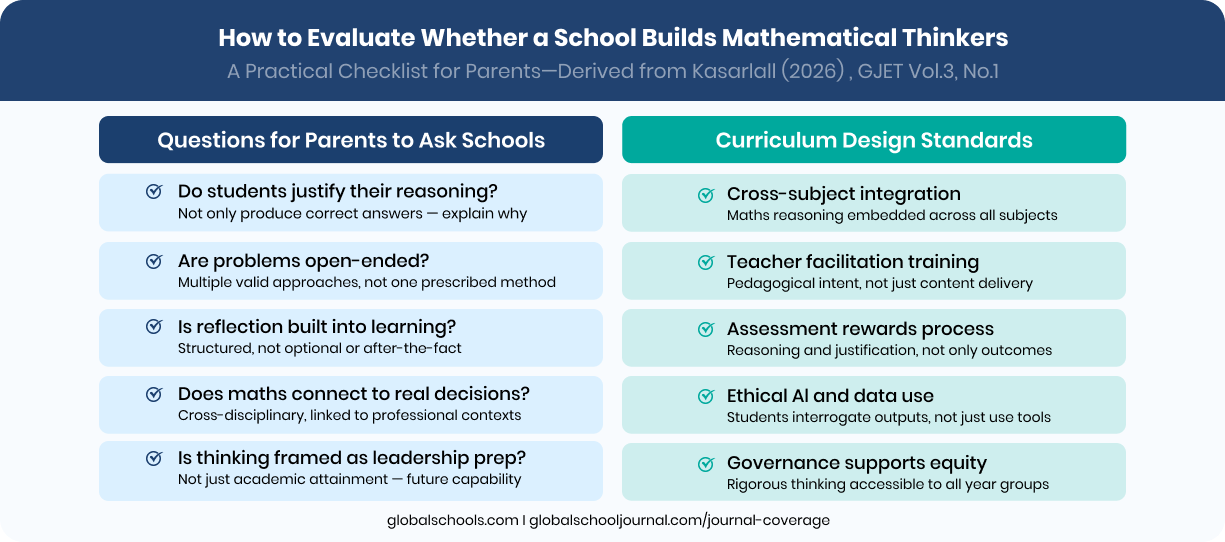
Parents can identify whether a school develops mathematical thinking by looking beyond examination rankings to the pedagogical practices used in mathematics lessons. The key indicators are whether students are asked to justify their reasoning, whether problems are open-ended with multiple valid approaches, whether reflection is built into the learning process, and whether mathematical thinking is connected explicitly to real-world decision-making contexts. These practices cannot be faked by high examination results alone.
Choosing the right school for your child involves more than reviewing league tables and examination statistics. It requires understanding how a school develops the cognitive capabilities that will determine your child's effectiveness as a leader, professional, and decision-maker throughout their adult life. Mathematical thinking is one of the most critical of those capabilities - and it is one of the easiest to overlook if you are only looking at grades.
Five Questions Every Parent Should Ask Any Prospective School:
- Does the school teach students to justify their mathematical reasoning, or only to produce correct answers?
- Are mathematical problems open-ended, with students exploring multiple valid approaches?
- Is reflective evaluation - assessing assumptions and conclusions - built explicitly into the learning process?
- Is mathematical reasoning connected to real-world decision-making contexts across subjects, not only in maths lessons?
- Does the school frame mathematical thinking explicitly as a preparation for leadership and professional life?
What to Look for Beyond the Classroom: School-Level Indicators
School Characteristic | Strong Mathematical Thinking Culture | Computation-Focused Culture |
Assessment design | Rewards process, reasoning and reflection | Rewards correct answers and method recall |
Teacher development | Trained to facilitate inquiry and reasoning | Trained to deliver content and correct errors |
Cross-curricular integration | Mathematical reasoning applied across subjects | Maths taught in isolation from other disciplines |
Real-world connection | Problems explicitly connected to professional contexts | Problems are abstract or textbook-based |
Student language about maths | Students can explain why approaches work | Students can recall which methods to use |
At GSG, all 64 campuses across 11 countries are guided by the same commitment: building students who think with rigour, lead with evidence, and adapt with confidence. Explore how our schools embed this approach across Cambridge and CBSE curricula at globalschools.com, read our latest thinking on the GSG Blogs page, and access the complete research framework underpinning this guide at the GJET Journal Coverage page.
Conclusion: From the Classroom, Into the Future
The core insight from our research is clear: how mathematics is taught today directly shapes the quality of tomorrow’s leaders. Mathematical thinking, including structuring problems, testing assumptions, analysing outcomes, and reflecting on decisions, is not a side benefit of education. It is its foundation. Schools and parents who recognise this are not just choosing a curriculum, but prioritising the development of future-ready thinking. The five core skills developed through rigorous mathematics, logical reasoning, problem-solving, quantitative analysis, modelling, and reflective evaluation, are the same capabilities demanded in leadership and remain difficult to replicate through AI alone.
For educators and school leaders, this calls for a shift in intent rather than content by embedding thinking into everyday teaching through reasoning, exploration, and reflection. For parents, it means looking beyond exam results to how a school develops a child’s ability to think. As highlighted in research published in the Global Journal of Educational Thoughts, schools that intentionally cultivate mathematical thinking are not just preparing students academically, they are equipping them to navigate and lead in a complex, data-driven world.